Legal
Engraving rules
We put marks into porcelain permanently enough that getting this wrong is expensive for both of us. These are the rules about content — what we can cut, what we will not, and how every upload is checked by a person before it goes anywhere near a kiln.
Last updated 13 August 2026 · Governing law: Denmark
What we can engrave
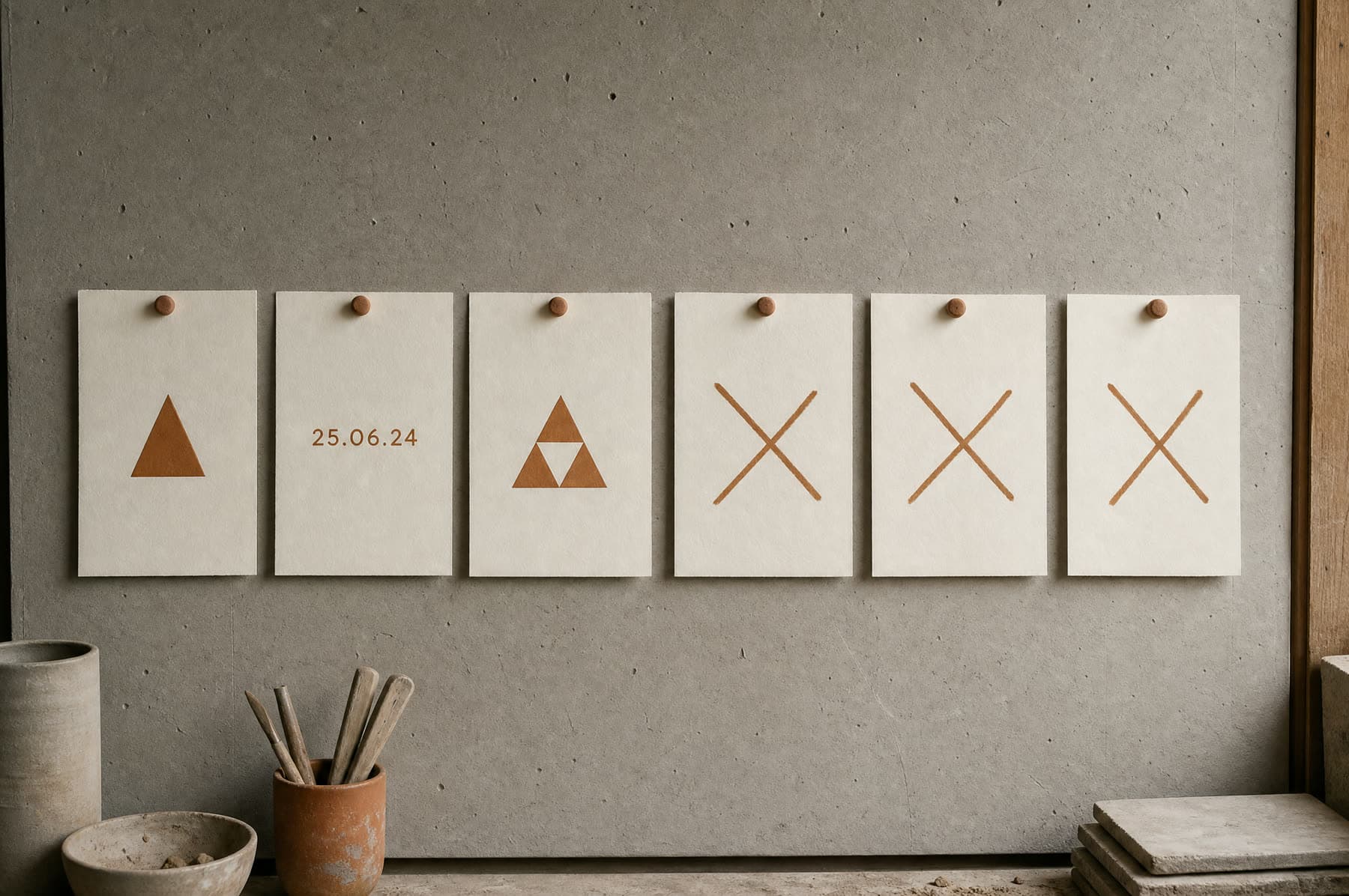
- Names, initials and monograms
- Dates and numbers
- Short lines of text
- The name of your own shop, café or studio
- Simple geometric motifs
- A logo you own or hold a written licence to use
Your own logo is fine — that is most of what the Café Line is for. You confirm at the point of ordering that it is yours or that you hold the right to use it, and that confirmation is checked again on our server before an order is created.
What we will not engrave
- Registered trade marks and brand logos belonging to anyone else
- Football club crests and university coats of arms
- Currency, banknote imagery, official seals and government emblems
- The likeness of a person who has not agreed to it
- Copyright-protected artwork, illustrations, photographs and typefaces you do not hold a licence for
- Content that is unlawful, or that targets a person or group
Why we refuse those
A trade mark, a club crest or a university arms belongs to someone. Cutting it into a hundred cups for a café is reproduction, and the person who owns it can act against both the café and us. The refusal protects you as much as it protects us.
Typefaces are the one people are most often surprised by. A commercial font licence usually does not cover cutting the letterforms into a product for resale. If you send us artwork with type in it, send it as outlines and confirm the licence covers this use — or use our own lettering, which is licensed for it.
Currency, banknote imagery, official seals and government emblems are restricted by law in most jurisdictions regardless of any licence.
Human review before firing
Every mark — typed or uploaded — is reviewed by a person before the piece is scheduled into a kiln. Nothing is fired on an automatic check.
The review has three states: pending, approved, and rejected with a written reason. Only an approved mark enters the kiln queue. That is enforced in the order system, not left to whoever is loading the kiln.
You can see the review state of every item in your cart and in your order confirmation.
If we reject a mark
We email you the reason within one working day. You then choose: send a different mark, or take a full refund. There is no fee either way, and nothing is charged for the work already done.
A rejection does not consume your cancellation window. If we reject on a Thursday and the kiln loads on Friday, your piece moves to the next kiln and the window moves with it.
How your files are handled
- Uploads go into private storage. They are not served from a public URL and are not indexable.
- Each file is given a random filename on receipt. The original name is not used in storage.
- EXIF and other embedded metadata are stripped server-side before the file is stored — including any location data a phone may have written into it.
- Access happens through short-lived signed URLs. No permanent link to your artwork exists.
- Files are deleted at the end of the retention period set out in the privacy policy.
- Your artwork is never used for marketing, never published, and never used to train any model. If we ever want to show a piece we made for you, we ask you first, in writing.
Technical limits
Content rules are only half of it. Each method has a minimum glyph height below which the mark loses definition in the firing: under-glaze 3 mm, on-glaze decal 2 mm, laser etch 1.5 mm. The configurator will not let you go below the minimum for the method you have chosen.
Each blank publishes its engravable area in mm². That is the usable panel inside the safety margin, not the whole surface of the piece. The configurator turns that area into a character limit for your chosen glyph height and stops you before the text runs off the panel.
For uploaded artwork, send vector where you can — SVG or PDF with outlines. A raster file needs to be at least 600 dpi at final size to cut cleanly. Fine hairlines below about 0.3 mm will not survive either the glaze or the laser.
If you are not sure whether something will work, order one sample first, or write to support@mkceramics.shop with the file. We would rather look at it than remake a batch.
Something unclear in this policy
Write to support@mkceramics.shop or call +45 21 45 83 76. We answer email within one working day. You can also use the contact form.